From practice
How AI agents are fundamentally changing software development
AI agents are taking on more of the implementation work. Domain knowledge, architecture and the ability to direct development are becoming more important. The modernisation of the aXpel shop shows what this means in practice.

Software development is undergoing a fundamental change. Modern AI agents do far more than write isolated fragments of code. They examine existing applications, implement features, write tests, improve interfaces, investigate faults, review infrastructure and help prepare production releases.
As a result, the ability to turn requirements into code is rapidly becoming less central. Domain knowledge, software architecture, technical judgement and the ability to guide agents and assess their work matter more. At the same time, custom software is becoming a more attractive economic proposition again.
Work on the aXpel one for all shop shows how these responsibilities are shifting. Agents carry out a growing share of the implementation, but someone still has to understand the system as a whole, interpret requirements and judge the quality of the results. Work that used to be postponed because of time, cost or complexity can now be completed surprisingly quickly.

Giving AI agents the right tools
The aXpel one for all shop sells packaging materials to business and private customers. Addresses, products, variants, prices and orders are synchronised with the Proffix ERP system. The frontend, built with Angular, and the .NET backend run on a cloud-native architecture in Google Cloud.
Angular itself has changed substantially over recent years. Core concepts and recommended practices have evolved, making a broad modernisation of the shop’s existing frontend necessary.
When working with coding agents, the right tools and up-to-date context are essential. Agents need to know how a framework such as Angular is used today and which practices now apply. That matters particularly during a modernisation, because a model’s training data does not necessarily reflect the current state of the framework.
Angular provides the Angular CLI MCP server for this purpose. Once connected to an agent’s development environment, it gives the agent direct access to current Angular information, tools and guidance. The agent can then base its work on current Angular concepts rather than relying only on what it learned during training.
Checking the application in a browser is also part of the process. Chrome DevTools MCP gives the agent tools to interact directly with Chrome: inspect pages, identify performance problems, check changes and measure their effects. This approach was used to analyse and improve performance and accessibility in the aXpel shop.
Experience is needed to direct agents
An agent can produce a technically sound implementation even when it has misunderstood the business requirement.
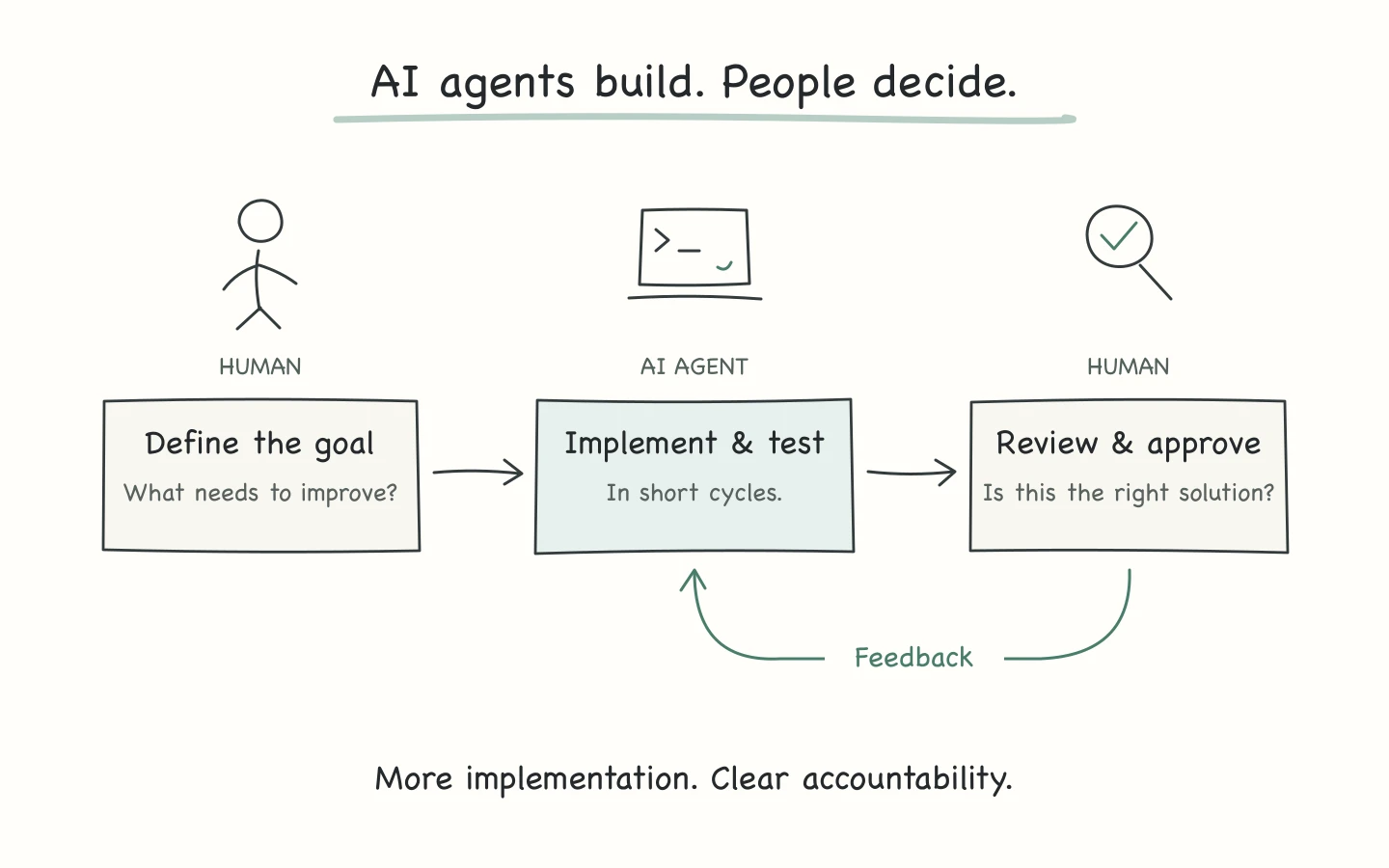
The ability to lead, domain knowledge – an understanding of business processes – software architecture and a broad technical perspective therefore matter more. Working with agents means defining sensible tasks, recognising dependencies and reliably judging whether the result is correct in both business and technical terms. It also means rejecting changes that work but make the application harder to maintain.
Another risk is that AI agents make solutions unnecessarily complex. Sometimes they go far deeper than the task requires, implementing processes or edge cases that will rarely, if ever, be used. Experience helps distinguish what is technically possible from what is actually useful.
In some respects, working with agents resembles leading a development team. Tasks need enough context, architectural decisions must fit together, and results need review. Daily use also makes it easier to judge which models suit which tasks and where closer supervision is needed.
Many changes can be made in a short time. That raises the demands on coordination, review and quality control. The emphasis in AI-assisted software development shifts towards shaping and directing the entire development process. The role of the coder disappears.
Automated tests make larger changes possible
The shop’s test coverage has been expanded considerably. Unit tests check individual functions and business rules; integration tests check how components and interfaces work together. End-to-end tests with Playwright run complete browser journeys, such as selecting a product and proceeding through checkout.
These checks are particularly valuable when agents change larger parts of the application. They reveal unintended effects on existing features early and allow changes to be checked repeatedly under the same conditions.
Agents can write the tests too. The expected outcomes must, however, be clearly defined. If the same misunderstanding is built into both the application code and its test, the mistake may go unnoticed. Reviewing tests and manually checking important business processes therefore remain part of quality assurance.
Another example is the Proffix mock server developed with agents. A mock server reproduces the behaviour of an external system without requiring every test to connect to that system. Here, it simulates the Proffix ERP interfaces used by the shop and returns predictable responses for specified API calls.
This makes it possible to test the Proffix integrations automatically and deliberately reproduce failures or unusual cases. The mock server is used mainly for integration tests. With the help of agents, this additional test infrastructure was designed and built in a very short time. The obstacle used to be the development effort, rather than technical feasibility.
Agents in infrastructure and operations
Agents also work on the technical environment around the shop. They have helped review and improve its cloud configurations. Logs are also regularly analysed using AI for possible errors, attempted attacks and unusual access patterns. Based on these findings, targeted Google Cloud Armor rules can be configured as needed to limit or block unwanted automated traffic, for example from scrapers.
Google Cloud Armor is a cloud-based web application firewall (WAF) with DDoS protection and intelligent traffic filtering.
AI agents have also helped improve deployment processes: how the application is built, tested and released to production in the cloud.
Smaller tools offer another example. An agent developed a program that synchronises CMS data and images entered by users in production with the staging and development environments.
Such tools can be valuable to a project. In the past, they were often hard to justify when development effort outweighed the benefit. AI agents change that calculation too.
Preparing the shop for AI agents as customers
While coding agents develop the application, another way of using the shop is emerging for its customers: personal assistants – themselves AI agents – that search for products and may eventually place orders. The aXpel project already includes initial WebMCP features for the catalogue, products and basket.
WebMCP is a proposed web standard that lets websites make their functions available to AI agents in a structured way. It is still in development, but already suggests how interaction with online shops could change.
Custom software is becoming more economical
One advantage of standard software is that its development costs are shared by many customers. When the effort required for a tailored solution falls, a closer fit with a company’s own processes becomes more valuable.
For the aXpel shop, the existing custom solution provides a strong foundation for further development. Features can be tailored to its products, customers and internal processes. The limits of an off-the-shelf shop system or individual plugins do not determine what the shop can do.
Possible next steps include more advanced analytics, a content agent to maintain product information and improve its search visibility, and three-dimensional configuration of customised products with Three.js.
These ideas illustrate the kinds of features that AI agents can make economically viable again.
Integration, maintenance and operations still need to be included in the calculation for custom shop solutions. What has changed is that implementing desired features can now much more often fit within a realistic budget and timetable. Companies therefore have reason to reconsider projects they previously set aside.