From practice
AI has solved the system integration problem.
Work that once required extensive analysis, complex programming and intensive testing can now be completed much faster and at lower cost with AI agents. Sound domain knowledge and reliable quality assurance remain essential.

Almost every company needs integrations between different IT systems. Developing these integrations has long been demanding and, accordingly, a lucrative business for IT service providers. Even seemingly simple synchronisation could require extensive analysis, long development times and complex test infrastructure.
AI agents have fundamentally changed this situation. Much of the technical work can now be completed significantly faster and at lower cost. The technical and economic barriers to custom integrations are falling substantially.

Why integrations require so much effort
The first step is to understand the systems to be connected and their interfaces. IT service providers cannot be familiar with every system, so they usually need to build up domain and technical expertise in at least one of the systems involved.
Once the technical capabilities have been explored, the real complexity emerges in the details. Consider an online shop that needs to connect to an ERP system. At first glance, the task seems straightforward: products are transferred from the ERP system to the shop, and shop orders are written back to the ERP system as sales orders.
However, it is not quite that simple. For example, product data from the ERP system needs to be presented as product variants and organised into user-friendly categories in the shop, even though the ERP data is often not structured for this purpose. Converting product descriptions often causes additional problems, for example when converting RTF to HTML. Translations may also be missing if the shop needs to support several languages, as is the norm in Switzerland.
There are also technical requirements for reliability. Even if one of the systems is temporarily unavailable, no data must be lost, and synchronisation must resume correctly afterwards.
Once the integration has been developed according to the analysis, it must be tested thoroughly, including potential edge cases. This takes considerable effort, as does setting up a suitable test environment, which may require additional licences and realistic test data.
Standard import and export tools cover many common use cases. However, they rarely fit a company’s business processes completely. What appears to be a standard solution soon becomes a custom implementation.
In short, developing reliable integrations requires extensive analysis, custom programming and careful testing.
What changes with AI
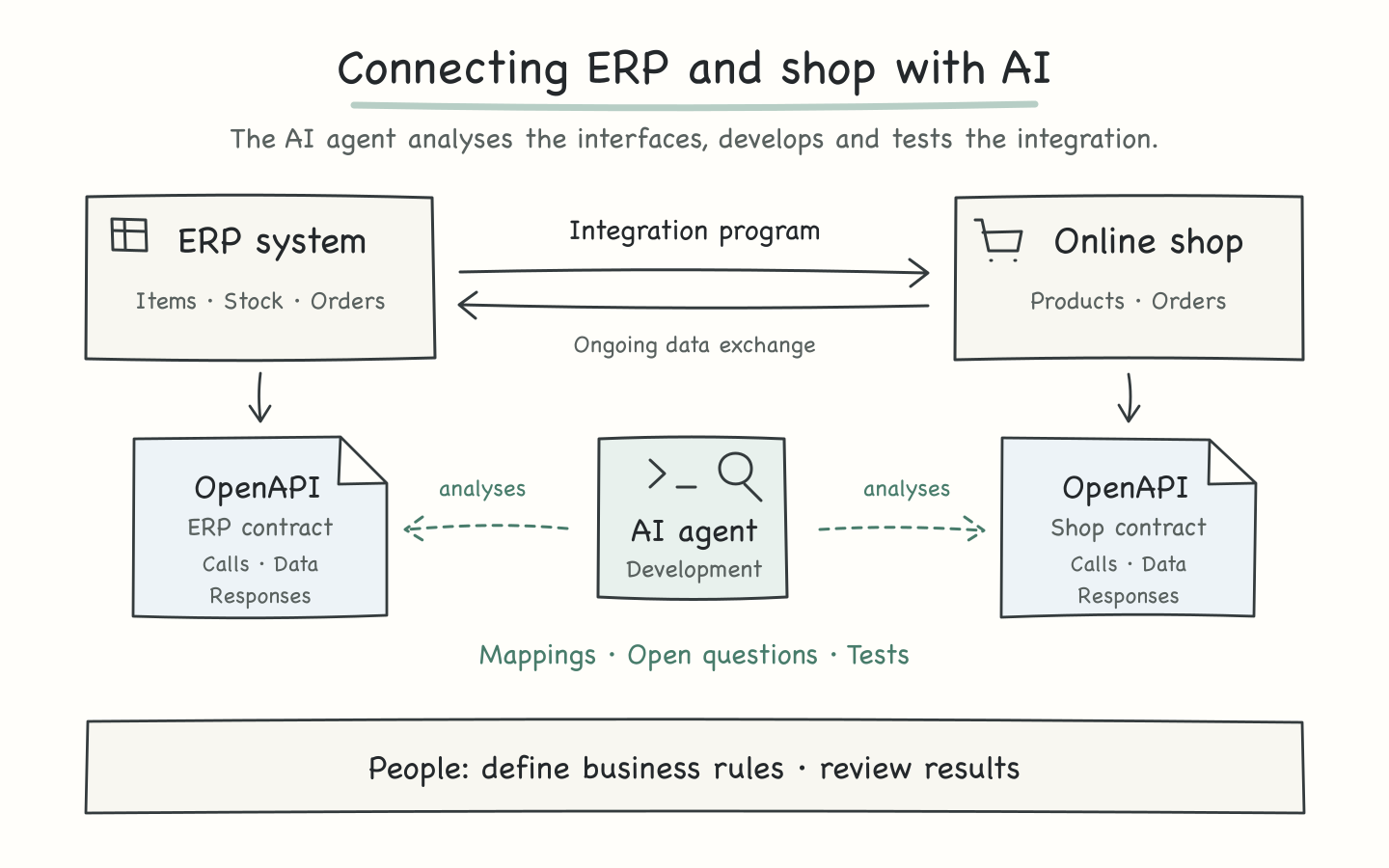
AI agents can analyse source code, data models and documentation. Machine-readable interface descriptions such as OpenAPI are particularly helpful. They describe a system’s available functions (API endpoints) and data structures.
This allows AI agents to identify and understand the technical capabilities of the systems to be connected. However, the data mappings and applicable business rules must be specified for them. With this foundation, the agents can develop and test the integration software largely independently.
Human domain knowledge and reliable quality assurance remain essential. Business requirements must be clearly defined, and the results must be carefully checked.
AI agents identify and handle edge cases
A particular strength of AI agents is their systematic analysis of potential edge cases. They can examine these scenarios, identify possible problems, implement appropriate error handling and create the necessary tests largely independently.
However, AI agents also tend to account for theoretical edge cases that cannot occur in practice. Here, too, people need to apply their domain knowledge to distinguish relevant edge cases from unnecessary ones.
Developing useful tools more easily with AI
Another significant improvement concerns test infrastructure. AI agents make it possible to develop tools such as mock servers with much less effort. These can, for example, simulate the behaviour of an ERP system and enable automated integration tests without requiring a complete ERP system to be available at all times.
These possibilities existed before. However, implementing them often involved a level of effort that was difficult to justify financially.
A mock server does not replace testing with the real ERP system.
New opportunities for businesses
AI has fundamentally changed the development of custom integrations. Work that once involved high costs and considerable time can now be carried out much more efficiently with AI agents. This also makes integrations attractive where companies had previously decided against them.
New opportunities are also emerging in document processing. In most companies, orders, invoices and other documents arrive by email. Employees have to read them and manually enter the information into an ERP system or another application. AI can analyse these documents and make the relevant information available as structured data, which can then be processed automatically.
AI is changing how we will work in the future. Companies therefore have good reason to reconsider their existing processes: where is data still transferred manually between systems? Where do employees have to extract information from documents? And which business processes could be automated with AI?